

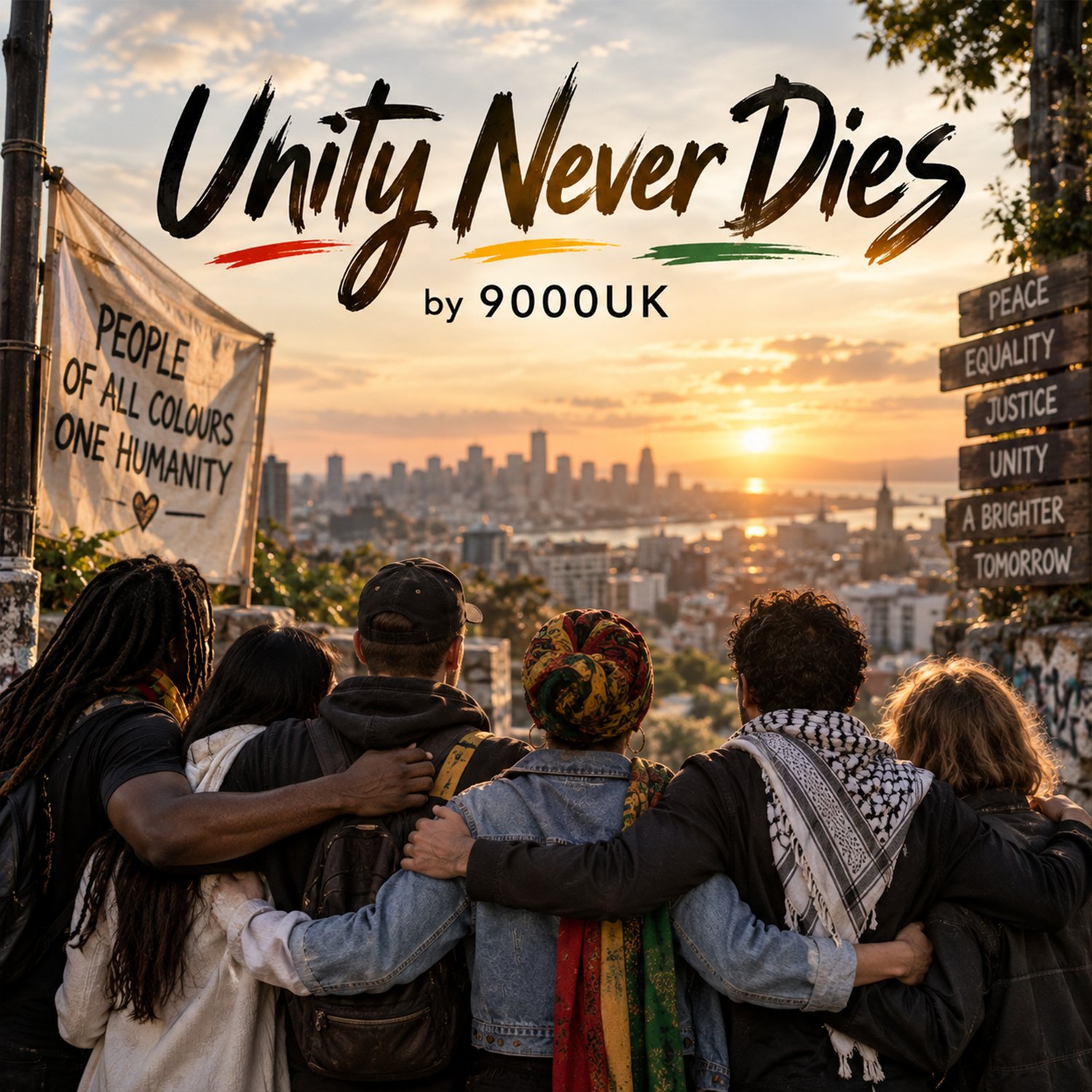
Unity Never Dies
All options include the full track download.
Support levels are optional and appreciated.
“Unity Never Dies” is a politically conscious reggae track that channels classic roots tradition into a modern declaration of resistance and solidarity. Framed through the symbolic language of “Babylon,” the song confronts systems of oppression that rely on violence, scarcity, and division to control people, while asserting that unity remains an unbreakable human force.
The intro immediately establishes defiance and grounding, positioning spirit as stronger than any external pressure. From Verse 1 onward, the lyrics do not soften reality: bombed spaces, cut resources, and deliberate attempts to instil fear are named directly. Yet these images are not presented to induce despair. Instead, they function as proof of endurance, showing that even when basic necessities are weaponised, collective strength continues to rise.
Unity is personified as a living force—“like a lion stand”—suggesting courage, dignity, and communal protection. The movement from “trench to hill” widens the scope of struggle, emphasising that resistance spans social and geographic boundaries. Truth and love are framed as unconfinable energies, immune to imposed limits or intimidation.
The pre-chorus reframes suffering as transformation. Pressure does not extinguish spirit; it converts struggle into flame. This section reinforces the song’s philosophical core: domination fails when people retain belief in their own worth and right to thrive.
The chorus serves as the track’s moral anchor. Repeated declarations that “the human spirit of unity never dies” turn the song into a chant-like affirmation, echoing traditional reggae protest anthems where repetition strengthens resolve. By directly listing tactics of control—bombing, starvation, misinformation—the song exposes power while refusing to submit to it.
Verse 2 shifts towards hope through humanity itself. Borders and barriers are portrayed as artificial, contrasted with the natural imagery of rivers, light, and roots. Children’s voices introduce generational continuity, reminding the listener that justice is not only resisted for the present, but claimed for the future.
The outro concludes with certainty rather than victory laps. Babylon does not fall through chaos, but through proximity to truth. Unity is reaffirmed as permanent, echoing forward rather than ending cleanly, reinforcing the idea that the struggle — and the bond — continues.
Overall, “Unity Never Dies” stands as a roots reggae statement of moral resistance: uncompromising in its message, grounded in cultural symbolism, and unwavering in its belief that no system can extinguish collective human dignity when people stand together.